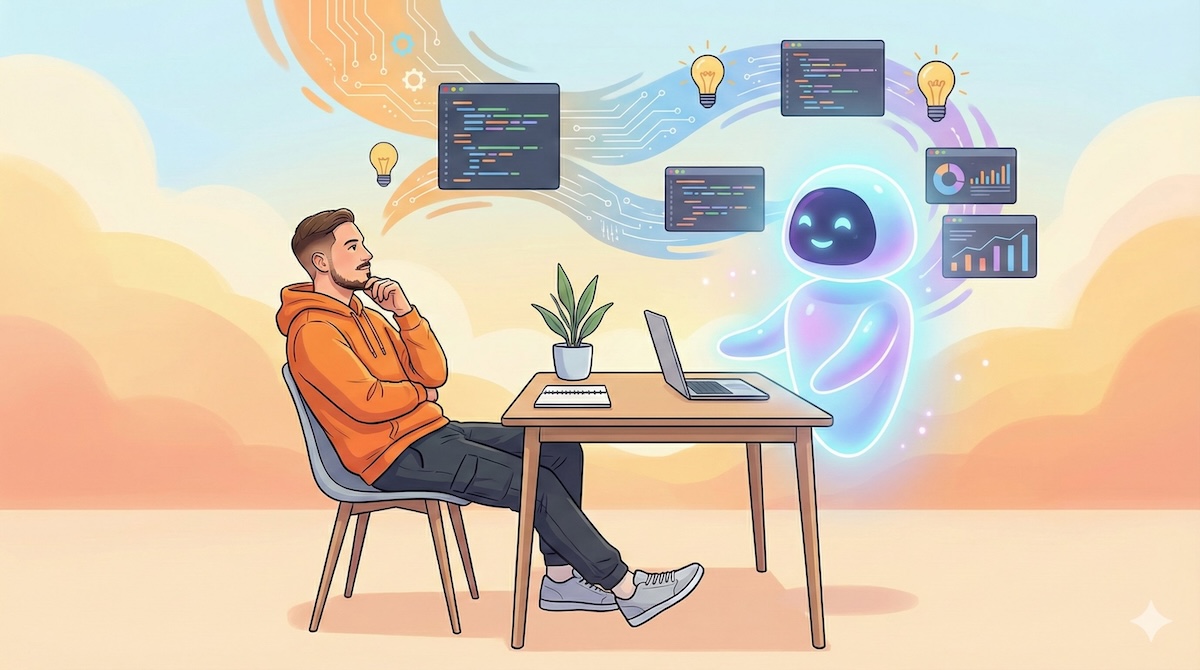
Thoughts on AI, Productivity, and What We Should Do Differently
In the last couple of months, I got to use Claude code a lot for software development, and I am at a point with it, where it gives me consistently high-quality results at incredible speed. In 99.5% of all cases, I get the results that I expect/desire. In other areas of my life, (other) AI tools have a drastic influence on my productivity and (sometimes) even my ability to do certain things, too.
This is wonderful. But, it also leads to plenty of questions and thoughts of how the world will change, and I believe that this depends entirely on us. Now, I am not the first person to write about this, I also will not be the last and this article can and will not be complete by any means. This article is more a random collection of thoughts than anything else. Writing it helps me to think, but I also hope it sparks more thinking and conversations around those thoughts. I hope you enjoy reading it.
We should be able to work less
I am not sure when we saw such a dramatic productivity gain in the past. Maybe during the industrialization. Perhaps even during the raise of the internet.
It will depend on your context, your work, and how you use modern tools, but let’s say AI only gives you a 25% productivity boost. – That would mean you could work one day less a week and still produce as much as before. And for me, I find my productivity gains to be more in the 5x - 20x range (sometimes possibly more).
Excluding the overwhelming science behind the benefits of a four-day-workweek for knowledge workers, this alone means that we should be able to work less without an impact on the productivity.
I would bet that we could now work 3-day work weeks and be more productive than 5 years ago.
Of course, history shows that productivity gains rarely benefitted workers as much as their employers and without an intervention, you will likely find yourself working 5 days a week for a slightly increased salary. – Therefore, I believe we should think about how much do we actually want to work and how our productivity is changing as our tools become better.
We should be able to earn more
Directly connected to my first thought is the question, what a fair salary, hourly rate, or compensation is.
I was always at odds with hourly-rate-based compensation (and salary mostly is a different form of it), as time-based compensation always means that someone doing the job faster and (maybe) even better, earns less money. This payment scheme incentivizes people to go slow, create extra work and do unnecessary things. It might be that is why we have so many meetings and so few automated tests and automated processes.
In our industry, we find people who will do things at an incredibly cheap hourly rate. Some of them are excellent, but many are “cheap” because of lacking experience. People who look cheap on paper sometimes are the most expensive ones—they create complicated, fragile code without clear architecture and quality assurance measures. Hiring the more expensive freelancer often is the more economical option, but I find it difficult to prove upfront how much faster or better I will be in any given context.
With the rise of decent AI tools, people with good software craft principles will find that their ability to create good and working software will be leveraged by a factor of 5x to 20x (again depending on the context, and it might be even more).
I have not tried to ask for an hourly rate of €800 yet, but my feeling is, that it wouldn’t sell as well. Maybe it is worth a try. Based on my experience, I would estimate that an €800 hourly rate today will result in a far cheaper price for a project compared to a €100 hourly rate 5 years ago. It would be a 8x gain for the worker and potentially another 8x for the company hiring them.
Again, you likely won’t see such an increase on your paycheck, but I believe these are the conversations we need to have now, as society, if we really want to benefit from AI.
I will stop doing hourly rate projects
For my existing clients, I won’t change a thing, as I try to keep things stable and “unsurprising”. But, I decided that for new clients, I will not make any hourly-rate-based offers anymore for the aforementioned reasons.
Instead, I want to have conversations about the desired outcomes and the value attributed to them. And then, if I believe I can make an offer that is well below that value, I will just do it. In the end, I do not want people to pay me for hours, but for results, and I think this is the fairest model I can imagine. I am aware that this means taking on the risk that things take longer than I have expected, but I am happy to carry this risk. I believe that there is no value in having huge unforeseeable projects with unclear duration and budget. If something is as big as that, the most value we can create is by slicing it down and identifying the first, most valuable increment and delivering just that. And this has always been a huge part of my work, anyway.
How will work change?
For me, personally
As a coach and consultant, I still work with teams and teach them how to develop software on-the-job. As a freelancer and as a solopreneur, I often find myself writing code alone. The only difference now is that my “writing code alone” feels more like a pair-programming session with Claude Code. From brainstorming the design over creating an implementation-plan to TDD-ing it into existence, Claude Code has become a reliable buddy.
This is great for me because I enjoy pair programming, but it always meant the need for synchronous time with others as well as the need to have others on my team (not the case as a solopreneur). Furthermore, not all developers enjoy pair-programming, and it also means we all need to have time at the same time (sometimes challenging when we are in very different timezones). Now I can get some of the benefits I got from pair-programming from the work with Claude and feel the need for real pair- or team-programming less often.
There is something bittersweet about this. I genuinely enjoy working with other humans—the unexpected ideas, the debates, the shared “aha” moments. AI doesn’t replace that. But it does scratch an itch when human pairing isn’t available, and I’d be lying if I said I don’t sometimes prefer the convenience.
For teams
If you are working in a team, I still believe real pair- or team-programming sessions are absolutely crucial. Mainly for knowledge sharing, teaching/learning, alignment, and team dynamics. I still find it much more valuable to code together the beginnings of a new feature or project than spending hours on upfront-planning. The code we write is part of the feedback loop to our understanding of the project or feature.
Currently, a working mode that I truly enjoy is to gather for a couple of team programming sessions at the start of a new feature, project, or product. Together, we set the foundations, guidelines and create a shared understanding of the goal and how we want to achieve it. We also identify areas where we can work alone without conflict. And then we spread out and code “alone”/with AI. We would then share updates / new interfaces / achievements asynchronously and come back together when we sense that something is not obvious. For me, this feels like a good balance between software teaming all-the-time and going full-solo-mode.
Team sizes will shrink
As we change how we work with AI and can create more things in shorter time and therefore also with fewer people, I would expect teams to become a lot smaller. Larger parts of our product can be maintained and evolved by fewer people. Today, a team of 3 can likely achieve what a team of 7-10 could achieve 5 years ago, just with way less communication lines.
Therefore, it became even more important, that we build teams around value streams and enable them to work independently. The worst thing that can happen is to have a team of 10 engineers working on entirely different things but having to communicate all the time for some artificial reason (dailies, status updates, someone’s need to feel important)
In smaller teams, having great team dynamics and knowing each other well usually becomes easier, and so does coordination and communication. I expect many challenges bigger teams face today to go away naturally, as team size shrinks.
This means, we will need and see less coaching on the team level, but potentially more on the organizational level, as organizations have to change, too.
Hierarchical organizations will fall behind (even more)
Traditional org design with hierarchies, management layers, organizing by function, and so on was always at odds with agile software development and business agility.
Many companies failed to become agile because they failed to let go of their strictly hierarchical structure.
To me, the goal of agile was to develop the right thing faster, by learning faster and reacting to that learning faster. In a nutshell, it was about faster feedback loops and continuous improvement. As (software) development accelerates, we require much faster feedback loops. We need to make better decisions as we work.
Top-down decision-making is very ill-suited for this. Companies where information needs to travel up the chain-of-command and decisions have to travel down the chain-of-command will not be able to keep up with the speed of innovation by companies working more in a self-organized, network, “flat” way.
We therefore shall see fewer managers in the future and inspirational leadership based on communicating vision, mission, and values will become even more important. Workers must be able to make good decisions quickly and get feedback from others or support in decision-making fast and on-demand.
Organizational structures must change faster as products will evolve faster, and new value streams might form more often, due to productivity increases.
Just having your quarterly OKR planning or monthly all-hands to communicate direction, might not cut it anymore.
The demand for good software engineers will NOT decrease
There is a lot of fear that we will lose our jobs or might be out of work. Of course, I don’t know the future, but what we see today is, that AI tools are great, but they are only tools. Different people have vastly different experience with AI. From my observation, great software craftspeople get consistently good results while using those tools. Others get mediocre results at best and have an overall frustrating experience.
It is less about the tools, but more about how we use them. Are we taking the time to learn how to use them? Do we have practices in place that allow us to use them well? Do we know what good looks like? Do we have high standards and principles, that we won’t compromise on?
Good software craftspeople will answer those questions with “Yes” and it will show in their output.
AI accelerates your ability to produce code. But at least today, end of 2025, it will not produce incredibly high-quality, maintainable code just because you ask it to do so. The gap between good software craftspeople and “just coders” will therefore become bigger as the first group is producing more high-quality code while the latter group is producing more technical debt, untested, and hard-to-maintain legacy code.
In conclusion, good engineers will be more in demand. To create high-quality products faster and to clean up the mess produced by those who did not know better.
Furthermore, I have yet to meet a team that doesn’t have a backlog nor a plan of what could be worked on next. There is plenty of work and an infinite number of ideas we could work on.
Economics has changed. We will work on different things.
I now find myself frequently working on ideas that I would not have touched a couple of years ago because the investment seemed too high for the anticipated return. Now, the economics has changed. If I can build something in hours that would have costed me days or weeks before, it is cheaper to try out things. And every so often we are surprised that those things are actually way more valuable than we have thought before we started.
Apart from the fact that AI itself is an interesting field where we see thousands of new startups and product ideas every day, AI augmented coding made it feasible to build products for niches that were economically uninteresting before.
If you have that product idea that you were afraid to build because it seemed too much work, just to try out if it will work, maybe now is the time to give it a shot.
Conclusion
I started this article by saying it’s a random collection of thoughts. And it is. But writing it down helped me see what connects them: AI is changing the economics of our work in ways we haven’t fully grasped yet. And if we don’t think about it intentionally, the benefits will flow to the usual places – not to us, our teams, or our lives.
We could work less. We could earn more. We could build smaller, more effective teams. We could finally move past organizational structures that never made sense for knowledge work in the first place. We could try out ideas that seemed too expensive to explore before.
But none of this will happen automatically. It requires us to have conversations – with our clients, our employers, our teams, and ourselves – about what we actually want from our work and how we value it.
I don’t have all the answers. I’m figuring this out as I go, just like everyone else. But I believe the worst thing we can do is to keep working the way we always have, just faster. That would be a waste of an incredible opportunity.
So, what do you think? How is AI changing your work? And more importantly – what do you want to do with that change?
I’d love to hear your thoughts.
— Tobi

Use the share button below if you liked it.
It makes me smile, when I see it.